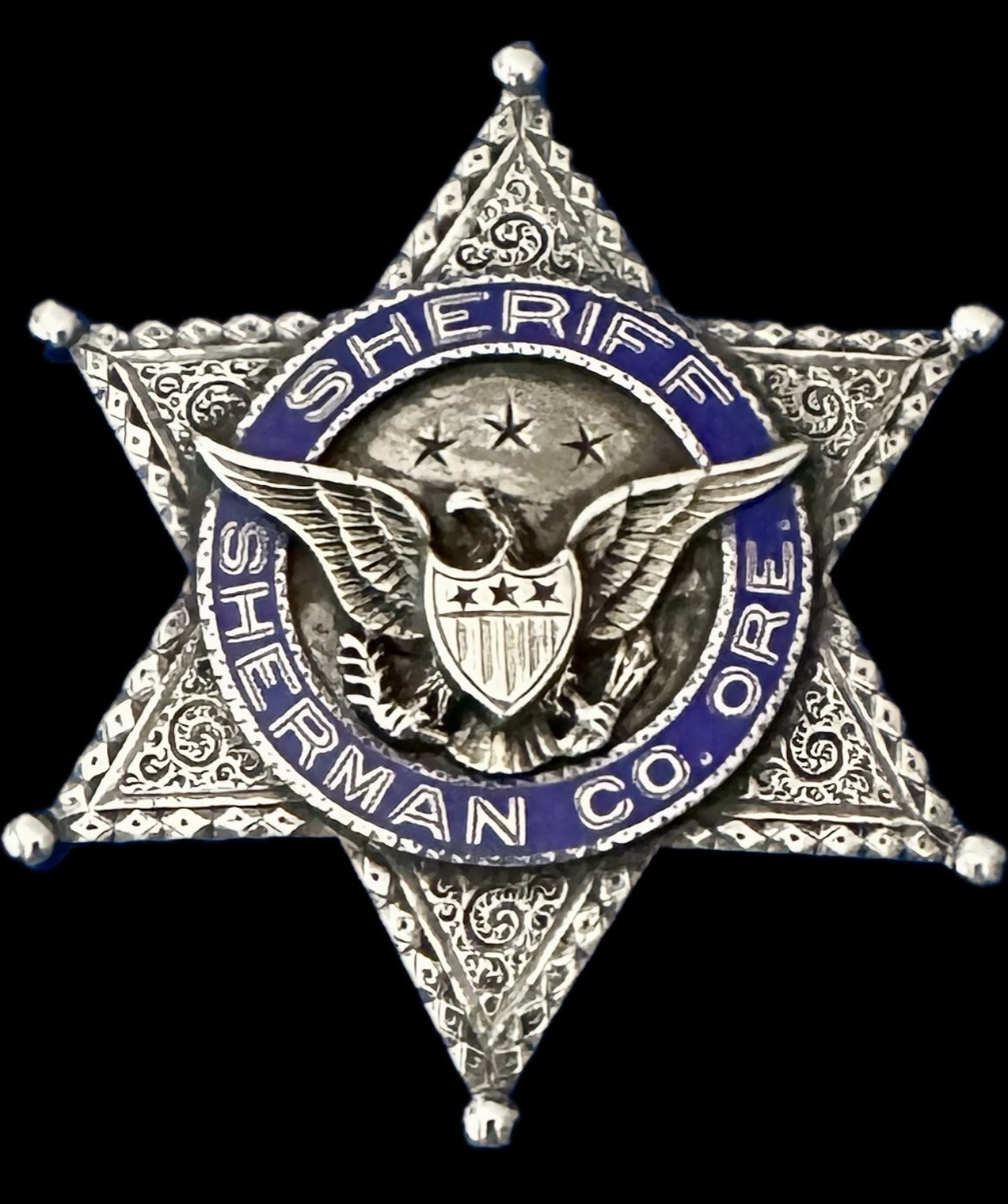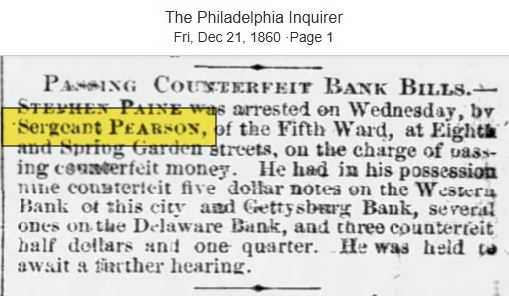
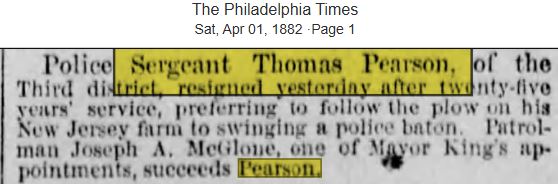
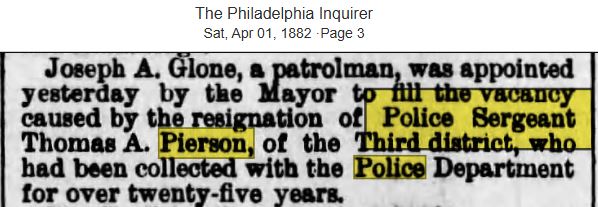
Philadelphia Police Sergeant Thomas M. Pearson (Pierson) was appointed to the department in 1857 and on May 22nd 1860 was promoted to the rank of Sergeant. He retired after 25yrs. service April 1, 1882.
Made by Taylor & Lawrey Silversmiths who were in business 1830 - 1875 in Philadelphia.
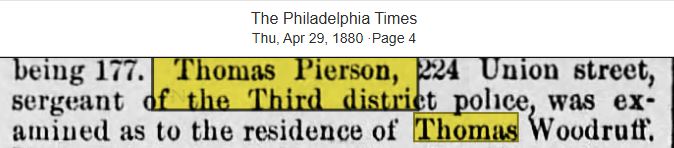
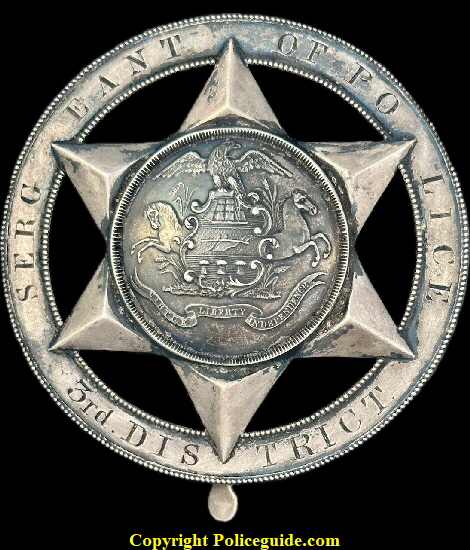
Philadelphia Police Sergeant 3rd District circle and star badge Presented to Sergeant Pearson by the Officers of the 5th Ward as a Token of their Esteem May 22nd 1860.
SKU 11789



1880 Federal Census
Name: Thomas Pierson
Name Variation Pearson
Age: 51
Birth Date: Abt 1829
Birthplace: Pennsylvania
Home in 1880:
Philadelphia, Philadelphia, Pennsylvania, USA
Street: Union
House Number: 226
Dwelling Number: 83
Marital Status: Married
Spouse's Name: Emma Pierson
Father's Birthplace: Pennsylvania
Mother's Birthplace: Germany
Occupation: Sergeant of police
Philadelphia’s police force in this era was a relatively new uniformed municipal department (formalized in the 1850s after consolidating districts), transitioning from earlier watchmen and constables. The 3rd District (sometimes associated with stations like the one on Union/Bremen Street in South Philadelphia or nearby areas) was one of several precincts handling patrols, arrests, and order in a growing industrial city on the eve of the Civil War. Promotions like this were typically announced in local newspapers such as the Public Ledger or North American, often in brief notices about departmental changes, but digitized records from that exact date are sparse and don’t turn up specific details on Pearson/Pierson in readily accessible online sources.
No prominent mentions, obituaries, detailed service records, or biographical sketches appear in historical texts, police histories (e.g., older works like those by Sprogle), or genealogical databases tied to this specific promotion. Common 19th-century spelling variations (Pearson vs. Pierson) and the era’s limited record-keeping for rank-and-file officers make tracing him challenging without deeper archival work. He does not appear to have been a high-profile figure involved in major incidents, politics, or later Civil War-related service that generated surviving documentation.
The 3rd District of the Philadelphia Police Department in 1860 was part of the newly reorganized municipal police force created by the 1854 Consolidation Act. This act merged the old city with surrounding districts into a single government covering about 130 square miles and roughly 500,000 residents. It established a uniformed police department with up to 820 patrolmen, replacing the earlier patchwork of night watchmen, daytime constables, and semi-private systems used in the pre-consolidation era.
Formation and Structure (1850s Context)
• Pre-1854: Policing relied on a night watch (dating back to 1751) and limited daytime patrols. The 1850 state law created a county police marshal and four countywide divisions to strengthen the force amid growing urban issues like riots, immigration-related tensions, and disorder.
• 1854 Consolidation: The law set district boundaries to align with the new ward system (wards and police districts were coterminous). The mayor appointed one lieutenant and two sergeants per district and could issue direct orders. Officers wore uniforms for the first time, marking a shift toward professionalization while remaining heavily influenced by political patronage—ward leaders often acted like de facto captains, and appointments frequently reflected party loyalty rather than merit.
• In 1860 (on the eve of the Civil War), the force handled routine patrols, arrests for vagrancy/disorder, crowd control, and enforcement in a rapidly industrializing city. Promotions like Thomas Pearson/Pierson’s to Sergeant on May 22, 1860, were typically announced in local papers and reflected service within this politically tinged system. Salaries were tiered by rank, and officers were expected to be American-born men aged 23–50.
Location of the 3rd District Station in the 1860s
Early police stations often occupied rented houses or converted buildings before the city constructed dedicated facilities in the late 1850s–1860s. For the 3rd District, historical images and references point to a station on Union Street (between Third and Fourth Streets, south side, in the area near Spruce and Pine Streets). It was sometimes called the Bremen Street Station (likely due to its proximity or association with Bremen/Union Street in South Philadelphia).
This placed it in what was then a working-class, densely populated South Philadelphia neighborhood. The district covered parts of early South Philadelphia wards, dealing with port-related activity, immigrant communities, industrial labor issues, and typical urban order maintenance.
Evolution of the 3rd District
• 19th Century: The district remained focused on South Philadelphia. Like other early districts, it operated with limited resources and was vulnerable to political influence and occasional corruption scandals that plagued the department in its first decades.
• 20th–21st Century: The 3rd District continued serving South Philadelphia. Its modern headquarters is at 11th Street & Wharton Street(South Division). A new combined 3rd and 4th District station opened there in the late 1970s or later. Today, it handles standard patrol duties, with crime statistics and community programs typical of urban districts.
Broader Context for Officers Like Pearson/Pierson
In 1860, a sergeant in the 3rd District would have supervised patrolmen on beats, responded to incidents, and answered to the district lieutenant (and ultimately the mayor or marshal). The job involved long hours on foot patrol in a pre-automobile, pre-telegraph-heavy era (though basic telegraph use for police communication began spreading). The force dealt with ethnic/immigrant tensions, occasional riots, and the social strains leading into the Civil War. Many rank-and-file officers left few personal records unless involved in notable events.
Formation and Structure (1850s Context)
• Pre-1854: Policing relied on a night watch (dating back to 1751) and limited daytime patrols. The 1850 state law created a county police marshal and four countywide divisions to strengthen the force amid growing urban issues like riots, immigration-related tensions, and disorder.
• 1854 Consolidation: The law set district boundaries to align with the new ward system (wards and police districts were coterminous). The mayor appointed one lieutenant and two sergeants per district and could issue direct orders. Officers wore uniforms for the first time, marking a shift toward professionalization while remaining heavily influenced by political patronage—ward leaders often acted like de facto captains, and appointments frequently reflected party loyalty rather than merit.
• In 1860 (on the eve of the Civil War), the force handled routine patrols, arrests for vagrancy/disorder, crowd control, and enforcement in a rapidly industrializing city. Promotions like Thomas Pearson/Pierson’s to Sergeant on May 22, 1860, were typically announced in local papers and reflected service within this politically tinged system. Salaries were tiered by rank, and officers were expected to be American-born men aged 23–50.
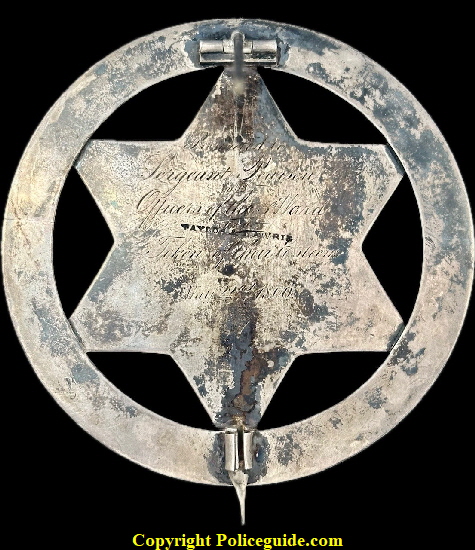
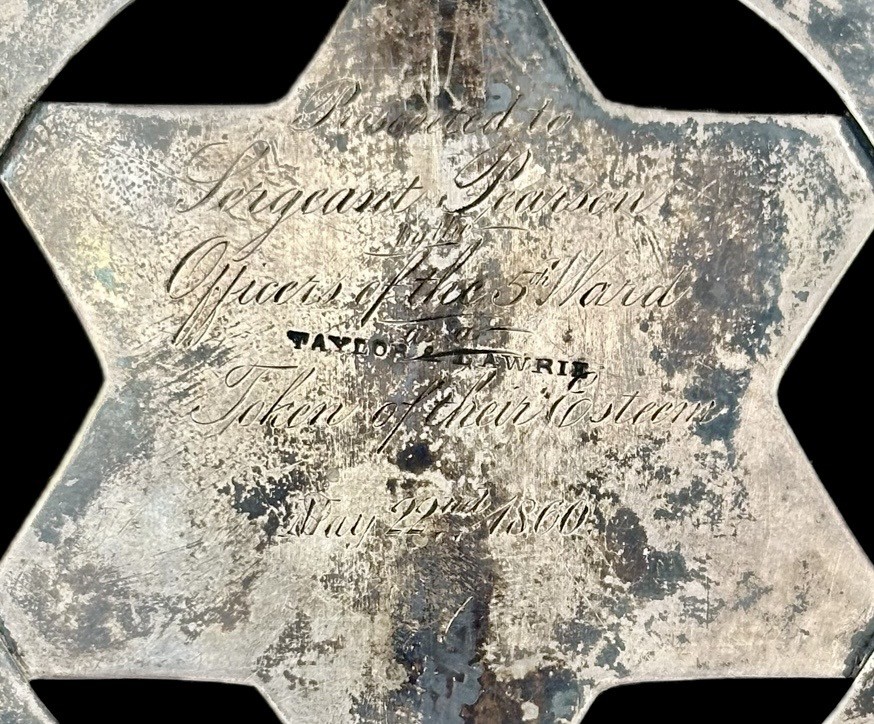
Presented to Sergeant Pearson by the Officers of the 5th Ward as a Token of their Esteem May 22nd 1860.




This site has over 300 pages so you may want to Search it with our custom search engine, AD FREE generated by Google.
Click Here
Lawman Online Badge Museum, Police Online Badge Museum, Sheriff Online Badge Museum, Constable Online Badge Museum.
Jim Casey’s Policeguide.com
Your guide to the wonderful world of badges.


This site has over 300 pages so you may want to Search it with our custom search engine, AD FREE
generated by Google.
Click Here